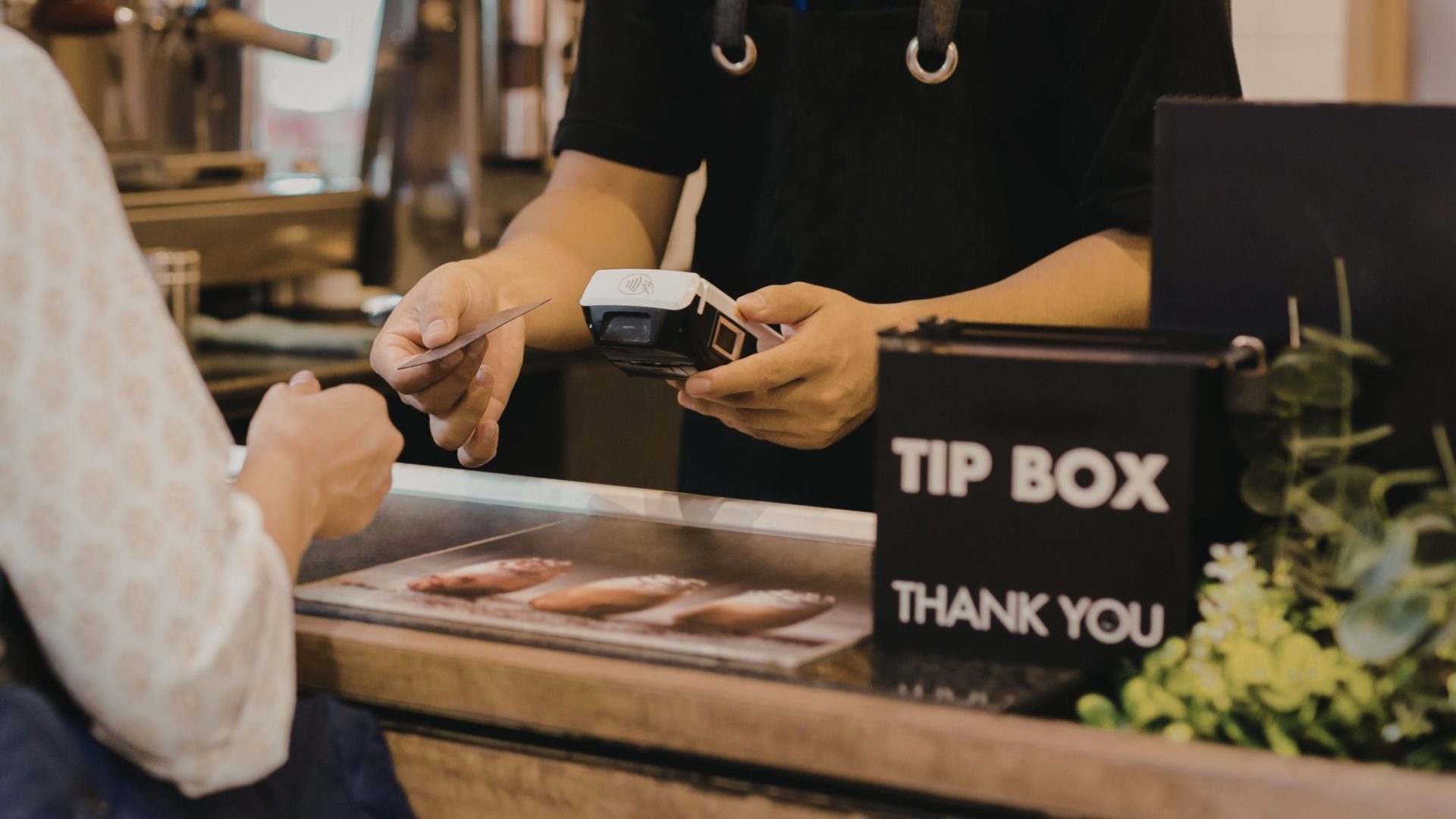
I consider myself an excellent tipper. I might even be overly generous, as a people-pleaser without proper regard for the value of money. (At least, that’s what my husband sometimes exclaims when it’s up to me to sign the bill.) But I’ve worked in the service industry, and I know that every single dollar is appreciated when you’re working for tips.
That being said, I know that I’m not alone when I gripe about all the different places we’re expected to tip people nowadays. It feels like almost every public transaction involves an iPad on a swivel and a worker desperately avoiding eye contact, waiting for you to decide whether or not you’ll tip them as you complete the transaction. In fact, a Pew Research poll notes that 72% of Americans say tipping is expected in more places today than a few years ago, a phenomenon that has been dubbed “tipflation.”
The days of the food service industry as the main industry asking for gratuities are long gone. Today you can be asked to tip almost anytime you pay for anything: buying makeup at the mall, at airport convenience stores (and I’m not making this up: there wasn’t even a person behind the counter!), even the guy who changes the oil on your car. Just 10 years ago, this wasn’t a “thing.” But now, you are confronted with the need to say “no” to tipping at almost every turn, which feels both unfair and unnecessary.
Digital Payment Systems and The Rise of “Tipflation”
In a Reader’s Digest article about this dilemma, etiquette expert Charlotte Hilton Anderson points out that our grievance isn’t necessarily with tipping itself, but with the reasons why tipping has become much more prevalent. The turning point, she and other experts surmised, came when businesses adopted iPad payment systems en masse during the COVID pandemic. These systems come with the tipping prompts built in, no matter what the transaction is actually about.
During COVID but prior to this change, tipping was considered a way to express your gratitude to “essential workers” who were performing their jobs at significant personal risk to themselves. But once the pandemic wound down and life resumed relative normalcy, the prompts to tip never retreated back to the software purgatory from whence they came. They stayed, and people slowly grew resentful.
Our resentment comes from the knowledge that many of the people standing behind the counter rely on our tips to make ends meet, because the minimum wage is nowhere even close to a living wage in many parts of the country. (As of early 2026, the federal minimum wage is just $7.25 per hour, an amount that hasn’t changed since 2009. Thirty states pay above the federal minimum wage, but there is still a gap between what workers take home and a true living wage.) We are angry because, as Anderson points out, “Tipping was originally designed to reward exceptional service, not to quietly paper over the gap between what employers pay and what workers actually need to survive.”
Etiquette expert Thomas Farley, aka Mister Manners, agrees, telling CNBC, “People are really feeling imposed upon. We’re already living through inflationary times. Everything is crazy expensive. And on top of that, you’re being asked, every time you turn around, ‘How much would you like to tip?’ It feels pushy, it feels needy and almost every customer I speak with says, ‘Why aren’t businesses just paying people more?’”
“The Nudge”
Now that almost everyone uses an iPad (or similar device) to process payments, it isn’t just minimum-wage workers who force you to contemplate a tip amount whenever completing a transaction. Tablet-based point-of-sale systems (POS systems, which I totally thought stood for something else) make it a matter of course to add a tip screen to any transaction, which gives businesses the ability to use a sales technique known as “the nudge.” This “nudge” — that moment when a worker is staring at you from behind the screen, while people behind you may be standing in line — creates social pressure that is difficult to overcome. Boston University School of Hospitality Administration professor Sean Jung says that the “nudge” is a real and measurable economic force: “If you have a system that kind of leads you to do something, it feels like a choice, but it isn’t,” he told NPR.
The people who benefit aren’t always the ones behind the screen, however. Square, the company behind a lot of the electronic payment screens, gets a cut of each transaction — including the tip, as NPR reported. And so the cycle begins: software companies create software that encourages tipping (and higher tipping rates), so tipping increases, benefiting the companies making the software as well as the businesses that won’t feel the same pressure to pay their employees a living wage.
Guilt-Induced Gratuities
Despite our annoyance, many people are still tipping, even when they don’t think they should have to. A 2025 Talker Research survey found that the average American was spending $283 a year in “guilt-induced gratuity,” tipping more than they wanted to around 4.2 times per month. Respondents attributed these tips to social pressure, guilt or the awkwardness of choosing not to tip.
Notably, these numbers are all lower than Talker Research’s 2024 findings, which had calculated that Americans spent $453 in guilt-led tips per year, tipping more than they wanted to on 6.3 occasions per month. This year, however, a significant number responded that empathy for workers contributed to their tipping choices, with 32% saying they tip more now specifically to support underpaid workers.
The Etiquette of Tipping
Although there isn’t any definitive consensus on when or where you have to tip, the experts generally agree on a few scenarios in which tipping is expected and appropriate. Other times, the situation depends on a number of factors, such as the quality of service and the kind of service that has been provided. And while there are myriads of scenarios to consider (what about ride sharing? Do I tip the pre-tax amount, or the total? And should I tip my oil-change guy??), here are just a few of the big-picture suggestions:
Definitely Tip:
If you’ve eaten at a sit-down restaurant or received beauty services (such as a haircut or manicure), you should factor in a tip as part of the cost. Robin DiPietro, professor and program director at the University of South Carolina’s College of Hospitality, Retail and Sport Management, told Real Simple that anywhere between 15%-20% is appropriate, based on the quality of the service received.
If drinking at a bar, it is standard to go for flat amounts rather than percentages, like $1 for a beer and $2 for a cocktail (unless you run a tab, in which case percentages work just fine). It is also customary to tip for food delivery services, especially if they were able to get your food to you while it’s still hot. (And keep in mind that a delivery fee is not the same as a tip!)
Grey Areas:
Just because the opportunity to tip is included at the kiosk or in the app doesn’t mean you have to tip. That said, most workers would be thrilled to receive a little extra something for their troubles, even if it’s not required.
According to CNBC, anyone working at a counter is earning a wage, so it isn’t an etiquette requirement to tip baristas or cashiers. “When they turn that device around, it’s this glaring thing, and people feel shamed into tipping, but you don’t have to,” Elaine Swann, a lifestyle and etiquette expert, told them. However, if someone has created a masterpiece of latte art or gone out of their way to make your order extra special, it would be a kind gesture to acknowledge their efforts with a small tip.
Also, Anderson suggests that context goes a long way when it comes to who owns the business, too: “There is a real difference between a locally owned craft coffee shop where a skilled barista is making you a genuinely complex drink and a chain deli where someone handed you a premade sandwich from a case. Both may have tip screens. They do not both necessarily warrant the same response.” The same goes for food trucks and merchants at a local market.
On the other hand, don’t succumb to “the nudge” just because it’s there. Remind yourself that in many cases, this prompt was put in place by the tech bros who wear expensive suits and vacation on their luxury yachts — not the teenager who is counting down the minutes until their lunch break.
Top image: Pavel Madalina’s Images, via Canva.com