

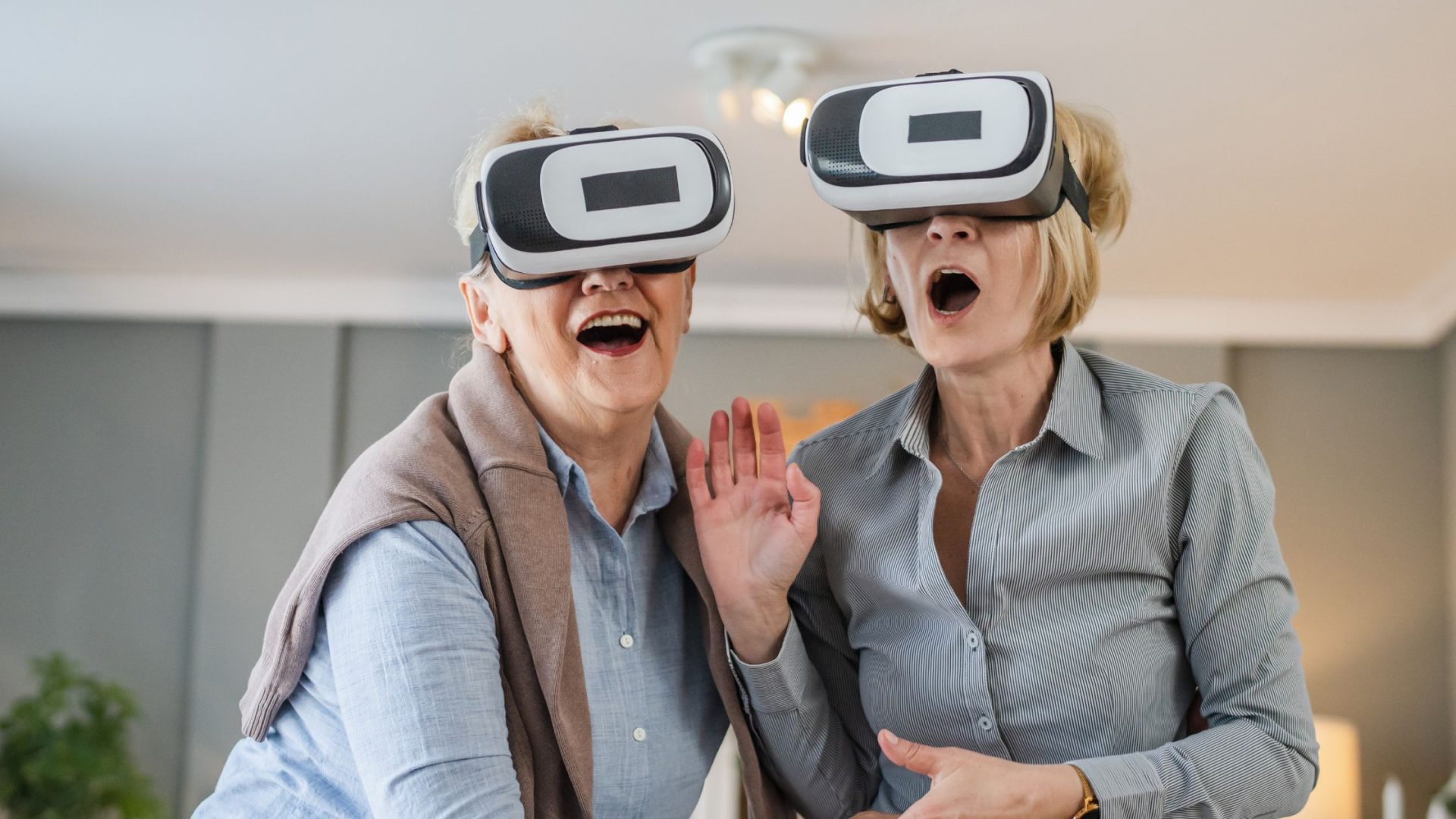
Getting in shape doesn’t have to mean grueling hours at the gym or monotonous workout routines. In fact, workout boredom and the difficulty of perceived effort are two of the challenges most likely to make you fall off the exercise bandwagon altogether. Ever since virtual reality (VR) burst onto the scene and into our homes about a decade ago, VR games have been revolutionizing fitness to make exercise fun, engaging and relatively accessible. Here’s what you should know if you want to hop on the VR fitness trend.
What Do We Mean by “Virtual Reality”?
To understand the concept of VR fitness, you first need to know a little bit about virtual reality headsets. Several options exist, ranging in price from about $300 (Meta Quest 3S) to several thousand dollars (Apple Vision Pro costs around $3,499). The differences between the models mostly comes down to image/graphics quality, motion tracking, available software and user experience. Having tried the Oculus (Meta’s earlier iteration that became popular during the pandemic), I can attest that even the cheaper options can be incredibly effective at altering your perception of your surroundings.
After you don the headset, which is like a heavy, futuristic pair of ski goggles, it asks you to “map” your surroundings by surveying the area around you. It then uses that data to project a visual overlay onto the screen, immersing you in a new, alternate reality. Then, using handheld controllers and motion-tracking technology, the device allows you to manipulate and interact with your virtual surroundings in a multitude of ways.
Types of Virtual Reality Fitness Programs
The very nature of VR gaming calls for a certain level of physical activity, because instead of controlling a digital avatar that performs tasks within the game, you are carrying out the actions yourself. Accordingly, the level of physical activity will vary depending on what kind of game you are playing. Virtual reality mini golf for example, while highly entertaining, isn’t much of a calorie-burner. Gorilla Tag, on the other hand — a game my children are obsessed with — leaves the player panting and dripping with sweat.
While you could achieve a certain level of physical fitness just by playing games that require a lot of movement, some programs are designed specifically with exercise as their goal. Games like Supernatural — one of the most popular VR fitness apps — feature virtual trainers guiding you through workouts like Boxing and Flow (the latter is like a Jedi training course without any of the Star Wars allusions). You swipe at orbs with virtual baseball bats, squat to pass through giant triangles, leg lift from side to side, and perform knee strikes to bust teardrop-shaped assailants.
More straightforward apps essentially transport the gym into your living room (or wherever you prefer to workout). Some of these programs, like Xponential+, project an energetic virtual trainer into your home to lead you through workouts from established studios like Pure Barre and Club Pilates.
What Makes VR Fitness Appealing?
There’s a lot to like about VR fitness options. For one, they don’t require any equipment other than the headset; no special dedicated space is needed, either. The workouts are self-selective, with no other classmates to judge you, and feature many levels of intensity so you can adjust your workouts precisely to your fitness level, goals and motivation.
Most importantly, VR workouts are fun, which is one of the best ways to keep people coming back for more. Brendon Stubbs, a fitness researcher at King’s College London, told science magazine Proto.Life that exercise that feels more like a game than a chore can help more people stay physically active. “For people who wouldn’t go to a gym, that wouldn’t go join a run club, wouldn’t go and join a football team or a tennis club — I think it is really exciting to help them experience the benefits and joys of movement.”
In the same article, Sam Cole, CEO of FitXR (another popular VR fitness service), noted that while many VR games struggle to retain users, fitness apps aren’t seeing the same drop-off. “Fitness [is] driving people to use the headset in a habitual manner,” he says.
In addition to being fun, current research on the efficacy of virtual reality-augmented exercise seems to support the fact that it is as impactful as it is enjoyable. Eight studies found virtual reality exercise to have positive effects on upper and lower limb function, fitness, body composition, balance, muscle function and strength. An analysis published in the Archives of Gerontology and Geriatrics also showed that VR games can improve physical function and balance, helping to reduce falls in balance-impaired older adults.
Getting Started
The prospect of spending hundreds of dollars on a device that might end up gathering dust in a drawer is daunting, to be sure. But when you consider that you might spend the same amount — or more — on a gym membership, the purchase starts to make a little more sense. As an added bonus, VR devices allow you to connect with other users over the internet. That makes it possible to work out with your sister who lives across the country, for example, or create a virtual fitness community of your own. At the very least, you might develop a penchant for virtual mini golf, which wouldn’t be all that bad.
Top image by alessandrobiascioli, via Canva.com