


Steering clear of retirement’s psychological pitfalls
Most people near retirement age aren’t focused on thriving in retirement; they’re focused on one thing and one thing only: their finances. Do they have enough money to live the lives they fantasize about when they leave their jobs?

But while being in a solvent financial position is certainly important, placing so much focus on the math of the next chapter can be an equation for a less-than-sanguine experience. Sure, the initial post-retirement months — often called the honeymoon phase — can feel heady and exciting. The freedom to take trips, perhaps tackle long-overdue household repairs, and basically do whatever the heck you want any day of the week can be liberating and, let’s face it, fun.
But what happens when that honeymoon is over? Days, weeks and months without structure can lead to boredom, anxiety and even depression. Suddenly retirement can feel like a sentence rather than an opportunity.
That reality is, in part, why more people are recognizing that in order to make the most of the next chapter, paying attention to personal needs should be just as important to retirement planning as making smart investment and savings choices. Instead of thinking of this next phase as retirement, a better term might be rewirement.
“I do think it’s a topic people need to think about. You need to think you need something to retire to. You need to have a life with purpose and meaning,” says Maureen Hannah, a Siena College professor of psychology and licensed psychologist with a private practice. “It can be very difficult. If you hate your job and you can’t wait to retire, that’s different from someone who had a job with great meaning for them and purpose. Meaning and purpose in life are important components for living an effective life.”

“Sometimes people are living longer in retirement than their careers were,” echoes Cyn Meyer, author of The Rewire Retirement Method: From Aimless to Amazing and founder of the Second Wind Movement. “It’s beneficial to leverage that and unlock new experiences and new opportunities.”
A 2023 survey of retirees and pre-retirees by the Retirement Coaches Association proves the need to rethink retirement planning beyond bank and retirement account statements. Called The Great Retirement Disconnect, the survey found that 76% of retirees had seen someone struggle with retirement. Of those, 53% grappled with the loss of identity, 32% were challenged by the lack of daily routine, 24% struggled with a lack of friendship and 18% were distressed by a lack of involvement in their community.
Nonfinancial fears from retirees broke out this way:
- 55% loss of purpose
- 45% staying up to date and feeling relevant
- 24% managing their time
- 21% deterioration of physical health
Pre-retirees, those who expected to retire within four to nine years, listed these as their biggest nonfinancial fears:
- 49% loss of purpose or direction
- 33% staying up to date and relevant
- 32% deterioration of physical health
- 18% deterioration of mental health
When asked about adjusting to retirement, 43% of retirees surveyed said it was harder than they expected, 45% said adjusting took longer than they expected, and 91% said having specific goals and plans for everyday life would have been helpful. Forty-eight percent of pre-retirees, meanwhile, thought adjusting to retirement would be easy, 52% said adjusting wouldn’t take long and 81% felt having specific goals and plans would be helpful.

While the numbers vary slightly, they all share a similar storyline: The disconnect between actual retirement and the idea of what retirement will be is real, and retirement is a major life adjustment that needs acknowledgment and planning to help make it smoother and more rewarding.
Richard Yerry regularly hears these concerns in his Warrensburg therapy practice. “The real, overarching psychological and spiritual issue is a change in identity, relationship, income and health,” he says. “At the core of that is what provides your life a sense of meaning and purpose. I work with a lot of clients who are struggling with retirement. I encourage them to stop and think. Look at the word. What is retirement? If you were going to explain it to a child, is it an age to access benefits or do you have other plans?”
Ultimately the options for finding purpose are as varied as the humans themselves. “A lot of people think, ‘How can I continue my career in a more volunteer or limited way?’” says Linda Mertz, who runs the Internships in Aging Project at UAlbany’s School of Social Welfare. Others, like her mother, delve deeper into hobbies. “Mom is almost 93 and she keeps saying she can’t die yet because she still has stuff to do.” Her hobby of collecting dolls has morphed into a second career of sorts, Mertz says, as she researches and writes about various dolls. “She feels she has things to contribute in the field,” Mertz says. “Those kinds of things are super important for people. Sometimes people think, ‘I’ll go to the gym more,’ but they’ve lost that part of the piece thinking about having a goal and purpose.”

“Think about your values in life — what gives you pleasure, what gives you meaning — and try to plan to incorporate that into your life,” advises Hannah, the Siena College psychology professor, who is 72 and still working. “Relaxing is fine, but in the long haul if you retire at 65 and live to 86, what are you going to do for those 20 years?
“Notice what activities and pursuits you do now,” she continues, adding that she loves to read. “What gives you pleasure now? Definitely have a plan.”
Helping people make a plan is exactly what prompted Meyer to become a certified life coach and create her Rewire Retirement Method — a process of changing the brain to unlock a fulfilling retirement lifestyle.
“My whole mission is to flip the stereotype of ageism on its head, uproot ageism,” she says. “The stereotype is that retirement is a time to wind down, take it easy, your heyday is over. That’s completely a lie. You have so much power and the tools and the brain. You just need the right system to unlock the opportunities and growth. It’s time to ramp up and do life in a more authentic way. You’re not tied down to the societal pressures of the middle. Growing older is a beautiful growth opportunity.”
It’s all about neuroplasticity, or the brain’s ability to reorganize and rewire itself. “We’re typically conditioned and stuck in these loops traveling the same neural pathways,” Meyer says, ticking off external motivators such as raising a family and building a career. “That motor has been running for decades.”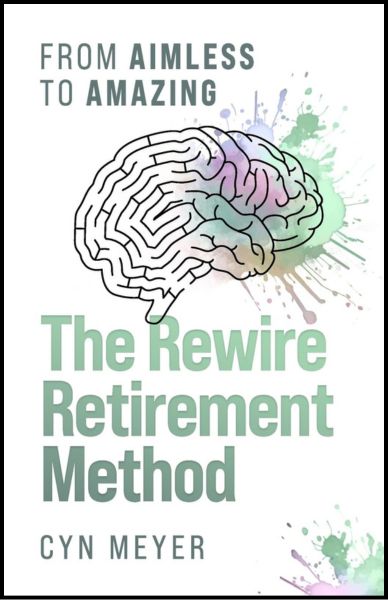
But the route can be changed, she says. “Tap into the magic of neuroplasticity. We can create new neural pathways. Instead of going to external motivators like career and money, reroute them to go inward for answers, a way that’s more aligned with your deeper desires and dreams and goals, a way that unlocks more and more opportunities.”
And to those who are nervous, Meyer offers this reassurance: “It’s worth it. It’s OK to face the fears of the unknown. Take one step. The ‘microstep’ is my mantra. Allow the momentum to expand. Like anything, it will be scary in the beginning but microstep your way through it.”
For copies of Meyer’s book or to learn more about her workshops and workbook, visit secondwindmovement.com.
All illustrations: iStockphoto.com/Liana2012l