


Writing your own final chapter
With the law now in effect, terminally ill New Yorkers have another end-of-life option amid a growing national debate
After years of passionate debate, New York’s Medical Aid in Dying Act (MAID) is in effect, allowing eligible terminally ill adults to request prescription medication to end their lives. The law represents a significant shift in the state’s approach to end-of-life care and reflects a growing national conversation about personal autonomy, medical ethics and the choices available to terminally ill people nearing the end of their lives.
In 2025, both chambers of the state legislature passed the measure, which allows terminally ill, mentally capable New Yorkers to receive prescription medication to end their lives peacefully. The bill, which had been introduced repeatedly since 2015, was signed into law by Gov. Kathy Hochul in February 2026 after she negotiated additional safeguards, and it went into effect on August 5.
Under the law, eligible adults must be state residents with an incurable, irreversible terminal illness expected to cause death within six months. They must have decision-making capacity and be able to self-administer the prescribed oral medication.
New York’s law is part of a broader national shift. New York and Illinois are among the most recent states to legalize medical aid in dying, with 13 states and Washington, D.C., now permitting the practice and more than a dozen states with bills under consideration. While New York and most other states require residency, Oregon, Vermont and Montana do not.
Supporters see it as an issue of compassion and autonomy; opponents call it a moral and ethical line that should not be crossed. But for many families, the issue is deeply personal.
A Family’s Turning Point
When Bob Thomas was diagnosed with terminal cancer in 2010, he wasn’t afraid of dying — he was afraid of losing control. A fiercely independent 76-year-old former meteorologist and lifelong outdoorsman, Thomas wanted to make his own decisions about his final days. Without options, however, at his lowest point, when he could barely walk or see, he nearly took his own life.
To be clear, Bob wasn’t suicidal, said his wife Barbara Thomas, referring to that pivotal moment just a year after his diagnosis. “He wanted to live, but his cancer chose to end his life. All he was asking for was assistance in ending his suffering when he couldn’t take it anymore. He asked me to get his pistol so he could shoot himself. … I didn’t, couldn’t do it. I loved him. I couldn’t watch him do that. I told him that everyone would know that I had helped him, that I didn’t want to go to jail for helping him, and he didn’t want me to go to jail, either. But I still feel guilty that I didn’t help him escape his misery.”
Bob ultimately died in hospice in 2012 at home in Saratoga Springs, cared for by his wife of 55 years. That experience changed her life, and she’s since been one of the leading voices in Albany advocating for MAID legislation.
“I’ve always felt people should be in charge of their own health, including their own death,” said Thomas, then 88, from her home in Schuylerville, where she now lives with one of her four sons. “I’ve been a strong supporter of bodily autonomy in all aspects of life. But I really got committed to the cause after Bob was diagnosed with brain cancer.”
Since her husband’s death, Barbara Thomas has become one of New York’s most persistent advocates for MAID, testifying before the legislature and attending nearly every hearing on the issue. “Far from being about despair, it’s about choice,” said Thomas, a former president of the League of Women Voters of New York who became the MAID issues specialist for the organization. “It’s about people reclaiming agency in their most vulnerable moments. In the end, even though Bob wasn’t in great pain, he was in agony.”
A Decade of Debate
The question of whether New York should legalize medical aid in dying has been on the table for about a decade. Lawmakers have introduced versions of the law nearly every session since 2015, facing intense and emotional testimony from both sides.
Advocates such as Death with Dignity, Compassion & Choices and the End of Life Choices New York argue that the law gives terminally ill adults more control over their final days. “When I testified before this legislature in 2018, we knew the path would be long and winding and full of roadblocks. Nevertheless, we persisted,” said Dr. Peg Sandeen, CEO of Death with Dignity, a national organization that advocates for MAID laws across the country.
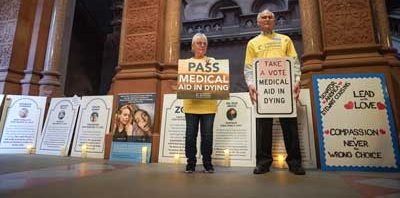
“This legislation is about easing needless suffering and honoring deeply personal choices,” said Assembly member Amy Paulin, one of the first sponsors of New York’s MAID law in 2015 and its author and sponsor in 2025. Paulin held a rally in Scarsdale in November 2025 urging the governor to sign the bill. She was joined by faith leaders, state and local officials and hundreds of advocates at Chase Park, which was lit up by 2,500 candles symbolizing the number of New Yorkers who die of cancer every month.
Opposition has been just as forceful. Religious organizations, disability rights groups and medical associations warn of potential abuse, diminished palliative care and a “slippery slope” toward euthanasia. The New York State Catholic Conference has been among the most vocal opponents, maintaining that MAID laws “send a dangerous message to society that when someone is considered a ‘burden’ to someone else, his or her life is no longer worth living.”
Long Island Assemblyman Daniel J. Norber (R,C-Great Neck), who voted against the MAID law in February, said the state must prioritize improving care, resources and support systems rather than advancing policies that fundamentally alter the role of medical professionals. “It should not create a framework that risks eroding our respect for human life at its most vulnerable moment,” Norber said. “I have profound respect for the dignity of every New Yorker facing the end of life. This amendment moves us down a path with serious and irreversible consequences for vulnerable patients and their families.”
From the Governor’s Decision to Implementation
When the bill reached Hochul in late 2025, she indicated she was considering signing it but wanted additional safeguards. Those included recording the patient’s request, a mental health evaluation, residency requirements and a delayed effective date. The final law reflects those additional protections.
The law requires an oral request recorded on video or audio, a written request signed by the patient and witnessed by two people, and evaluations by an attending physician and a consulting physician. A psychologist or psychiatrist must also evaluate the patient’s decision-making capacity. The attending physician must explain available alternatives, including hospice and palliative care.
The law also requires a five-day waiting period between when the prescription is written and when it can be filled, unless the attending physician determines the patient is not expected to survive five days. The patient must perform the final act of self-administering the medication; a health care professional or another person cannot administer it.
Hochul, a practicing Catholic whose mother died of ALS in 2014, acknowledged during a press briefing in September 2025 that the decision weighed heavily on her. “I have to be very careful not to allow my beliefs to color my decision-making when I’m making a decision not for myself but for 20 million New Yorkers,” Hochul said.
After signing the legislation on February 6, Hochul said the law would give terminally ill New Yorkers the choice to reduce suffering while ensuring safeguards to protect patients and prepare medical institutions.
What’s at Stake
For Barbara Thomas and other MAID advocates who sent letters to the governor and testified at legislative hearings, the issue isn’t political — it’s human. “This isn’t about giving up on life,” Thomas said. “It’s about living the way you want to live, right to the end.”
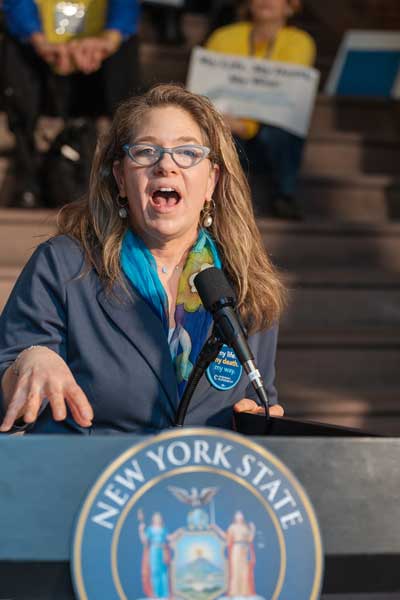
Before Hochul signed the bill, Corinne Carey, New York senior director for Compassion & Choices, argued that every day of delay meant more suffering for New Yorkers who wanted the option. Carey and others, including dozens of terminally ill patients and their families, met at the Capitol in October 2025 to press the governor to sign MAID into law.
“The people you see behind me, some of whom are terminally ill, want to know that this will be an option for them when the next bad scan comes, when the next test result tells them they have far less time to live,” said Carey, speaking to the group gathered just steps from the governor’s office.
Now that the law is in effect, attention is turning to how it will be implemented and how patients, families and medical professionals will navigate the process.
The New York State Department of Health has not yet released precise official figures regarding how many requests have been made or fulfilled, but it is required to publicly report on the program annually.
The Health Department has published eligibility information, frequently asked questions and guidance for health care professionals, along with proposed reporting requirements. The state’s official information is available at its Medical Aid in Dying portal.




 goes into effect.)