

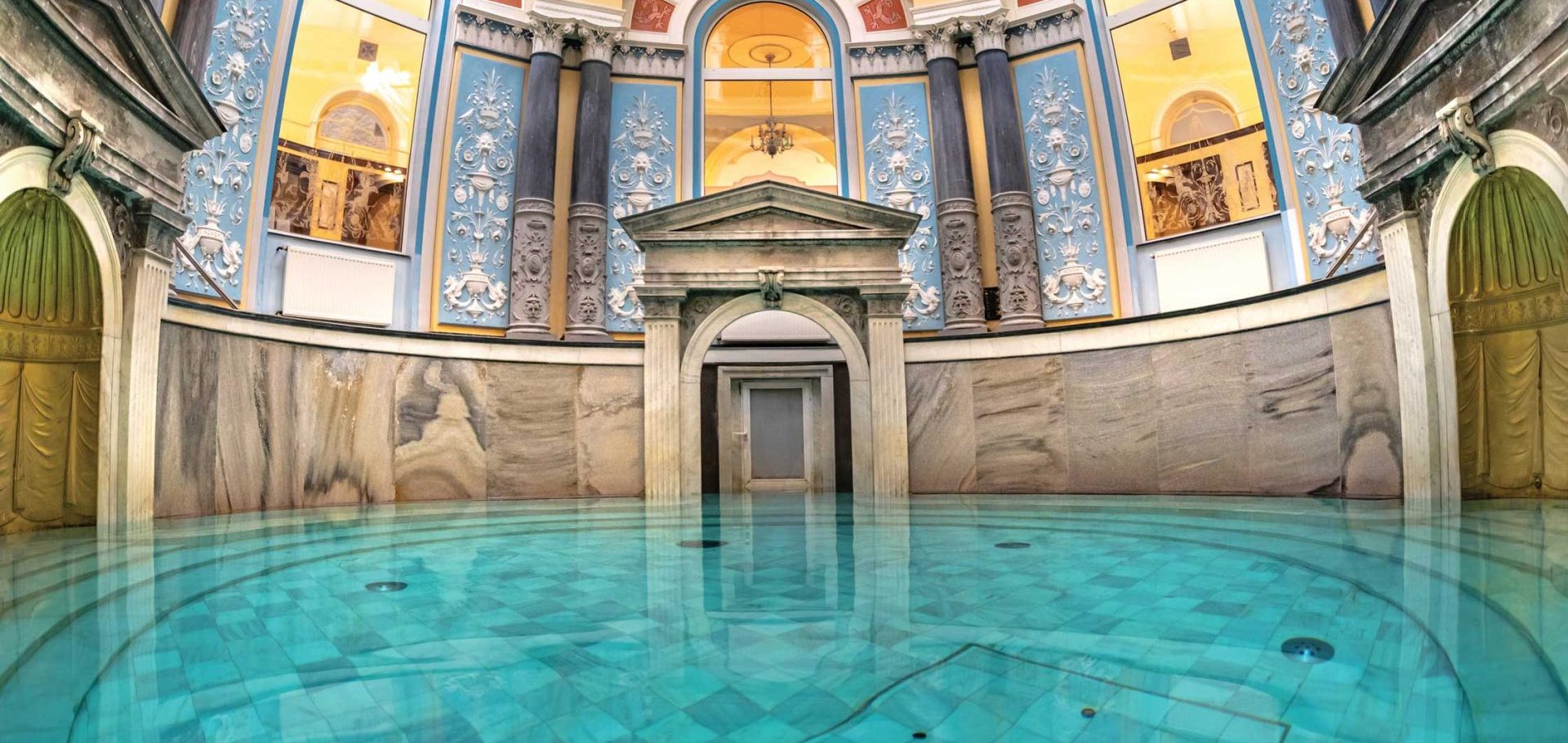
Steeped in history and brimming with rejuvenative powers, Europe’s thermal spas have long been a magnet for travelers seeking the perfect blend of relaxation, luxury and healing waters.
“Spa towns in Europe were really the first tourism destinations,” Simone Zagrodnik explained by phone from Wiesbaden, Germany. “The kings and queens, they went to the big spa towns and the whole country followed.”
In order to properly accommodate these seasonal migrations of nobility and their retinues, entire towns arose around the waters, complete with elaborately designed theaters, sophisticated train stations and other cultural institutions. These were places to see and be seen, where great composers, authors, artists and, later, scientists congregated to produce some of their most famous work.
Eleven of Europe’s most extraordinary examples were officially recognized in 2021 as part of a cultural tourism route on UNESCO’s World Heritage List of “The Great Spa Towns of Europe.” These sites were honored with the designation because they grandly tell the story of the European spa phenomenon. It’s a tradition that has been developing, in some cases, since Roman times, turning small villages (like Lądek-Zdrój in Poland, which still has a population of just 5,500) into tourist destinations. They all have superlative examples of spa architecture that house mineral and thermal springs, in addition to extensive parks, gardens and “therapeutic spa landscapes,” where strolls along networks of specially built pathways were prescribed as part of the cure.
As the executive director of the European Historic Thermal Towns Association, Zagrodnik is on a mission to preserve, protect and promote tourism to the spa towns, as well as over 40 more historic thermal spa locations.
“From Portugal to Turkey, you have small towns, big towns, you have huge cities like Budapest, and you have super small villages where they use their thermal waters to water their gardens,” says Zagrodnik. “That’s what makes it so interesting and totally challenging at the same time.”
Each town celebrates its own heritage as part of the European spa phenomenon, so to see one doesn’t mean you’ve seen them all. The sites on UNESCO’s Great Spa Towns list are the grandest, the “crème de la crème,” says Zagrodnik, noting a few destinations she’d particularly recommend:
Chaves-Verín (Eurocity), Spain and Portugal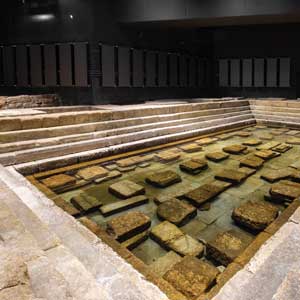
Chaves-Verín is a “Eurocity,” the result of a program that saw two countries working together for the development of a shared territory rich in mineral waters and a common history.
On the Portuguese side of the Tǎmega River is Chaves, a vibrant market town famous for its spas, historic center and tasty presunto (smoked ham). Today, you can visit the ruins of the Roman thermal baths — the Aquae Flaviae (“the waters of Emperor Trajan”) — as well as other Roman ruins such as a theater, a forum and a temple/sanctuary. Overlooking the medieval square, Praça de Camões, is an impressive 14th-century keep with a small museum, as well as the Baroque Misericordia church, with its exquisite interior lined with 18th-century glazed tiles. The thermal spas have long been used for the treatment of joint diseases, and for musculoskeletal, gastrointestinal and respiratory problems. Most notably, however, Zagrodnik reports that the waters have a high concentration of lithium, which has the effect of making your skin incredibly smooth. “Their water, it doesn’t smell like sulfur, and when you put your hand in one of the fountains, your skin instantly, almost, stretches. It [becomes] so soft and super smooth.”
Crossing the River Tǎmega into Verín is an ancient stone bridge built by the Romans that is still used today. Although the town of Verín dates back to the 16th century, the mineral waters were not widely used until the 19th century when they rapidly became a popular drinking treatment. In 1859 the first buvettes — little temples where people came to sample the waters — were established. The Fontenova Spring buvette still provides mineral drinking water today.
Both Verín and Chaves’ thermal spas are endowed with modern equipment and many of the latest therapeutic treatments, but if that isn’t enough, just south of Chaves is Vidago, a historical thermal health center that has been favored by several members of the Portuguese royal family over the years. There, in addition to the modern thermal spa, is an elite 18-hole golf course, a five-star luxury hotel and a magnificent palace.
Budapest is world famous for its historic spas, even earning the title of “Spa City” back in the 1930s. The city straddles more than 100 underground thermal springs and houses some of Europe’s largest and most impressive public baths, each with its own iconic style.
Perhaps the most famous is the Hotel Gellért, a stunning art nouveau hotel built over springs that have been used since the 15th century. In the 18th century, the “miraculous” waters were known as sárosfürdo, or mud baths, because of the abundant fine silt that would deposit at the bottom of the pools. This silt was left by water containing higher-than-usual percentages of calcium, magnesium, hydrogen-carbonate, sulphate-chloride, sodium and fluoride ions — all of which have medicinal properties. For hundreds of years, people sought out these waters for treatment of rheumatic diseases (arthritis) and circulatory conditions. Inhaling the steam from the springs was known to alleviate some respiratory ailments, as well.
Budapest’s Széchenyi Thermal Bath is one of the largest spa complexes in Europe, with springs for both therapeutic bathing and drinking. The pipe room provides drinking water used for gastric and metabolic disorders as well as certain gallbladder afflictions. But what really makes Széchenyi spas unique, according to Zagrodnik, are the massive “SPArty” celebrations thrown every Saturday to bring in younger crowds.
“They play dance music in the thermal bath,” she says. “There’s a light show, and they serve drinks.”
Caldes de Montbui (Catalonia), Spain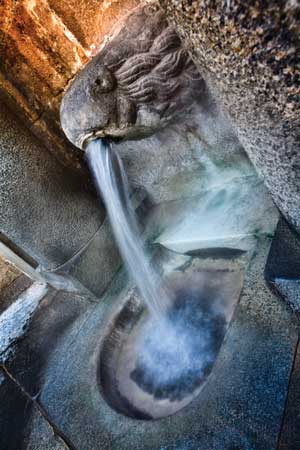
Nestled in the foothills of the Pyrenees, Caldes de Montbui is a charming town just a 45-minute drive from Barcelona. Documents from the 17th century confirm that Caldes de Montbui’s spa traditions go back to Roman times. The iconic Font del Lleó (Lion Spring) situated in the middle of the old town center was originally built in 1581, renovated in 1822 and restored again in 1927.
Boasting some of the hottest thermal springs in Europe — a steaming 165.2 degrees Fahrenheit — the people of Caldes de Montbui can easily say they have come up with some of the most inventive uses for thermal water. In addition to the spa facilities, they use water from the springs to supply the communal laundry houses, constructed in the 19th century and still in use today, water their gardens, and brew huge cauldrons of thermal broth in the town square at Christmas. Pasta Sanmartí, a local pasta company, has even been making artisanal pasta with thermal water since the 1700s.
Montegrotto Terme, famous for its mud and spa treatments for hundreds of years, is an easy 40-minute train ride from Venice. Having mostly merged with nearby Abano Terme, the springs are part of the Euganean thermal zone, where waters from the Lessini Mountains emerge — at 188.6 degrees — full of minerals and salts.
The curative properties of the hot springs were already known as early as the Iron Age, and archaeological records indicate that an ancient lakeside sanctuary existed here between the late 8th and 3rd centuries B.C. In Roman times, Montegrotto Terme was an important thermal center, with the virtues of the hot springs praised by Hippocrates himself. Near the main street, visitors can see the remains of the original Roman bathing complex (termas romanas) — three interconnected pools and a small theater.
Montegrotto Terme is especially renowned for its thermal muds, which are particularly prized for relieving pain associated with osteoarticular diseases (rheumatism, arthritis and osteoporosis). The preparation of the thermal mud takes several months, during which it is “matured” by combining three elements — solid or land (natural clay), hydromineral (thermal water) and biological (microorganisms and biomaterials). The resulting spa product is the only one to have been given a European patent and is ranked in the highest classifications by the Ministry of Health.
As an additional perk, unlike some of the smaller thermal spa locations, Montegrotto Terme has over 30 nearby hotels.
Baden-Baden, Germany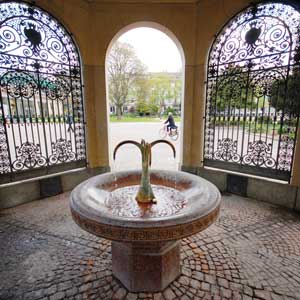
One of the 11 cities included in UNESCO’s list of “Great Spa Towns,” Baden-Baden might perhaps be a more familiar name to American travelers.
At the Friedrichsbad spa, visitors undergo a 17-step ritual combining Roman and Irish bathing traditions, alternating between hot and cool waters and various baths. (Zagrodnik says visitors to German spas generally bathe in the nude. However, the Friedrichsbad hosts “textile bathing days” on Wednesdays and Saturdays, for which people are expected to wear swimsuits.)
At the end of the 19th century, Baden-Baden experienced a construction boom and was known as the summer capital of Europe, where an international crowd would gather for social and cultural events. Today, visitors can still admire the gorgeous Festspielhaus, one of the largest classical music venues in Europe); visit the “most beautiful casino in the world,” according to Marlene Dietrich; and stroll through the neo-baroque Old Town.
Top image source: Municipality of Chaves (Município de Chaves)