
Filling your home with living plants is undeniably uplifting. Adding easy-to-manage varieties such as ferns, pothos, and snake plants can instantly make a room feel more alive and inviting. Tending them can also give us a small, satisfying daily ritual — watering, pruning, watching new growth unfurl — that boosts our mood and brings a touch of nature indoors. Some houseplants, when well-cared-for, can live for decades and be passed down through generations, becoming a point of pride and a deeply sentimental way to honor someone’s memory.
In order to keep those verdant vibes going, it’s important to recognize common problems houseplants face. Even experienced green thumbs sometimes encounter issues they’re not familiar with, whether it’s a plant they’ve had for years or they’re branching out in a new direction. (Ask me about my recent obsession with raising carnivorous plants. Now there is an exercise in trial and error!)
Although some maladies might be specific to a plant species, many signs of plant distress are universally shared amongst all kinds of varieties. Even if you’re a dedicated plant-parent, issues can (and will) arise that you might not be familiar with. So, as a refresher, here are a few of the most common houseplant maladies and their solutions.
Houseplant Triage
We’ve all been there: a plant that was doing beautifully just a while ago is suddenly screaming for help. It might be wilted, or yellowing, or — heaven forbid — shriveled and mushy. It’s time to perform some houseplant triage.
You’ll need to keep in mind that many problems aren’t caused by a single factor; they often result from several factors coming together to cause an unhealthy or unattractive plant. So part of houseplant triage is to identify the primary issue. For example, treating symptoms such as fungus gnats with insecticide won’t help if the root cause (which is often wet soil) isn’t addressed.
Once you’ve performed the following assessments, many common houseplant problems can be divided into three categories: Improper conditions/Poor Culture (watering, fertilization, pruning etc), Insects and Pests, and Diseases.
Improper Conditions and Poor Plant Culture:
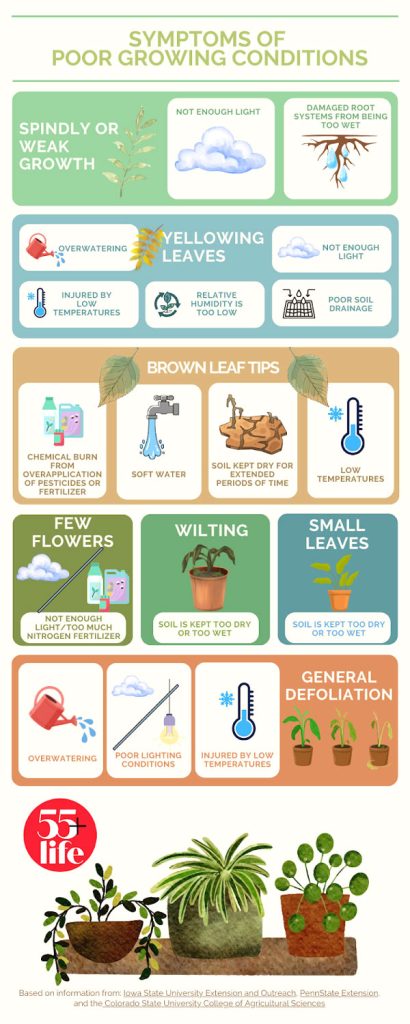
The first step to assessing any houseplant issue, according to the Iowa State University Extension and Outreach Program (ISUEO), is to determine whether the environmental conditions are still appropriate for that particular plant. Has anything changed about its location, temperature, humidity, lighting, watering, or soil content? Are certain needs not being met, or are you just guilty of giving it too much love water? If so, you’ll need to find a way to adjust the conditions to better meet its needs.
Some common signs of inappropriate growing conditions and houseplant care include:
The Gap of Death
As you can see from the infographic, under- and over-watering is often the culprit behind unattractive or ailing houseplants.
One of the most obvious watering issues is a gap between the edge of the soil and the container in which the plant sits. A gap between the soil and the pot is primarily caused by soil shrinking due to extreme or extended periods of dryness, soil degradation, compaction, or when the plant becomes root-bound. When you water a plant with this Gap of Death, all the water will run down the sides so that the soil — let alone the roots — can’t absorb it.
There are several ways to fix this problem. If you know the gap is due to forgetful watering habits, you can often reinvigorate the soil by bottom watering (placing the pot in a sink or tub filled with water for several hours, so the soil can rehydrate from the bottom upwards), or loosening and poking holes in the soil with a chopstick or pencil to allow water to penetrate. If the plant hasn’t been repotted in over a year, or if you pull it out and notice that it is badly rootbound (ie. roots have grown to take up most of the space), then your best bet is to repot the plant with some fresh soil.
Pest Problems
Pests can (and do) happen to all good plant parents. They are most often introduced when you bring home a new plant, or when you move plants that have been outside indoors for the winter. Some pests are incredibly difficult to eradicate completely — I’m looking at you, mealybugs — but with the right arsenal of chemical treatments, physical manipulation and some stubborn perseverance, it can be done.
According to the PennState Extension, the houseplant pests you are most likely to encounter are aphids, fungus gnats, mealybugs, mites, scale, thrips, and whitefly. Learning what each of these bugs look like, and the usual signs of damage they cause, is critical for effectively managing any infestation. (For more detailed descriptions, the Colorado State University College of Agricultural Sciences is a fantastic resource.)
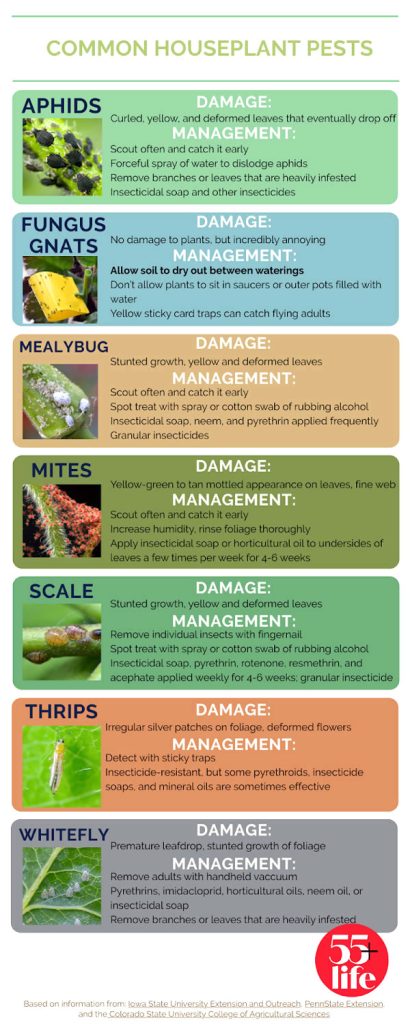
In general, you should try to inspect your houseplants regularly for any signs of pests, because it is far easier to get rid of them if you catch an infestation early. Be sure to look at the underside of leaves, along stems, and on growth points. Remove and destroy any heavily infested branches or leaves, and in some cases, you might consider destroying heavily infested plants before they infest other plants in your home.
Common Houseplant Diseases
When kept in optimal conditions, most plants experience very few disease problems. However, plants can get stressed without their preferred growing environment, which makes them more susceptible to infection. Like pest infestations, it is best to catch any signs of disease early so you can intercede before the plant is too far gone.
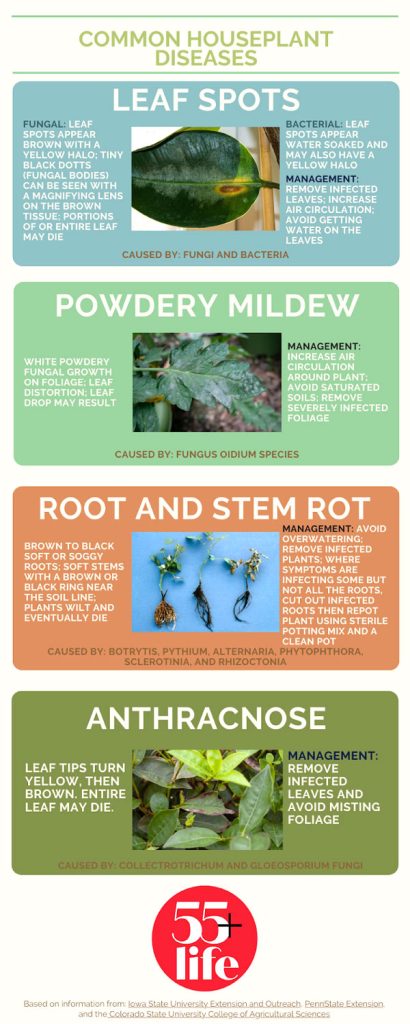
In addition to removing affected areas and adjusting the environmental conditions that led to the problem, fungal issues like spots and mildew can usually be managed with chemical fungicides (such as copper soap, chlorothalonil, or neem oil) or countless other natural remedies. The internet is filled with tried-and-true recipes from home gardeners, like this one from FTD (the flower delivery service):
- 1 Tbsp baking soda
- ½ tsp non-detergent soap
- 1 gallon water
Bacterial infections, unfortunately, are often untreatable, and will likely end poorly for your beloved houseplant. All you can do is remove affected areas quickly, avoid crowding or splashing water on the foliage, and apply copper soap or Bacillus amyloliquefaciens spray to reduce the incidence of future disease, according to the Halton Master Gardeners.
Top image source: Africa images, via Canva.com