

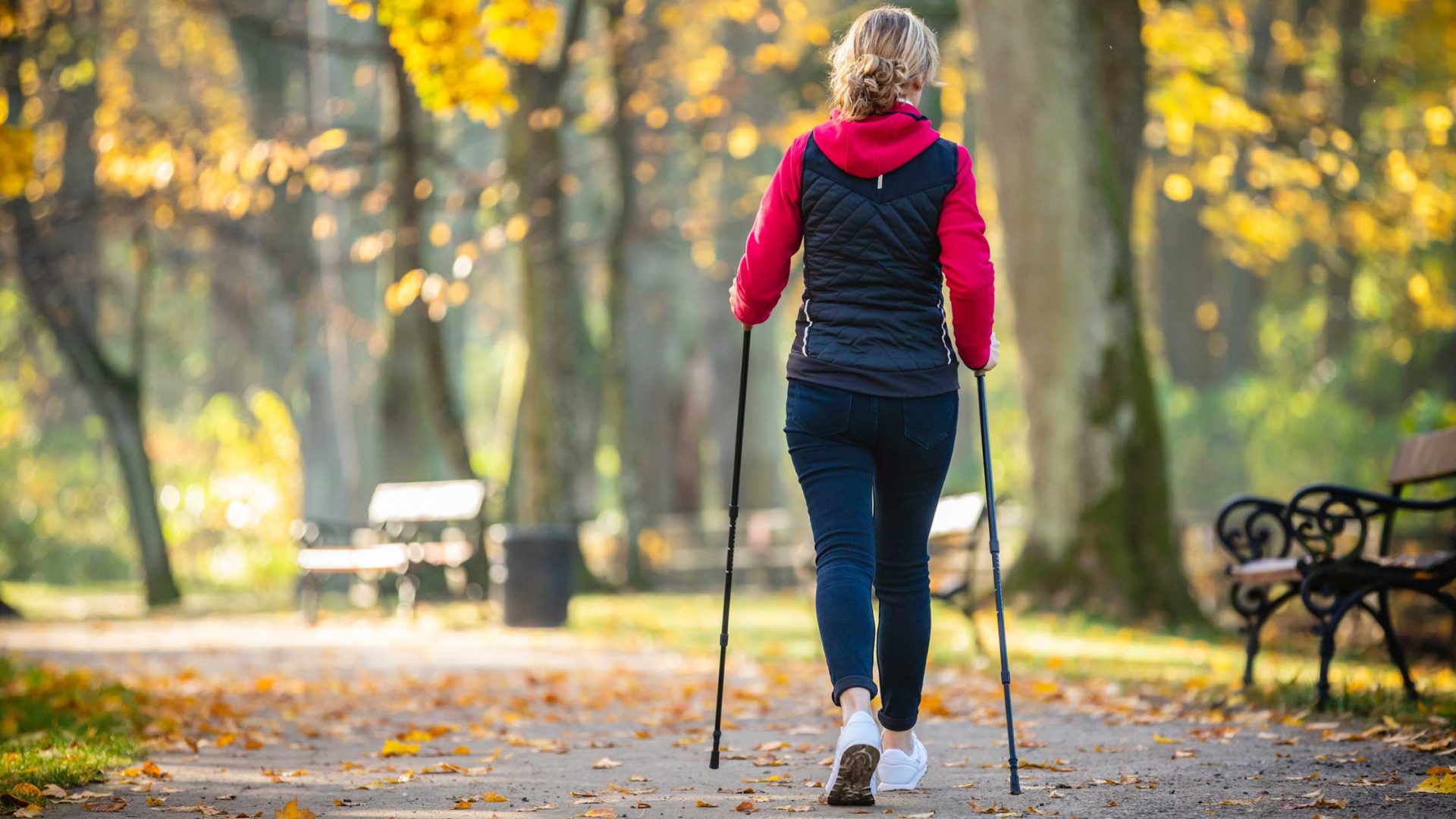
Nordic walking is an excellent exercise to take up, whether the required poles are helping you navigate slippery woodland paths or a city sidewalk. And once you get over feeling just a tad goofy, you’ll find that the added exertion of using your shoulders to propel yourself forward makes it a highly effective workout.
What is Nordic Walking?
Nordic walking originated in Finland as a way for athletes from the perennial cross-country skiing powerhouse to train when there isn’t any snow on the ground. But this low-impact, full-body exercise quickly became a popular pastime for people across Europe, and it is catching on in the United States, particularly among older adults.
Using specialized poles (because is it even a sport if there isn’t specialized equipment?) Nordic walkers mimic the motion of cross-country skiing without the awkwardness of having long, unwieldy planks attached to their feet.
The Health Benefits of Nordic Walking
Nordic walking combines the cardiovascular exercise of walking with a vigorous muscle workout for your shoulders, arms, core, and legs. Cardiologist Aaron Baggish became enamored with the sport when he spent a year of work and study in Switzerland, where seemingly everyone took to the hills each weekend with their poles: “When you walk without poles, you activate muscles below the waist. When you add Nordic poles, you activate all of the muscles of the upper body as well,” he told Harvard Health. “You’re engaging 80% to 90% of your muscles, as opposed to 50%, providing a substantial calorie-burning benefit.”
According to Harvard Health, research has shown that the sport of nordic walking is also associated with reductions in fat mass, “bad” LDL cholesterol and triglycerides, depression, anxiety, chronic pain, and waist circumference, and increases in “good” HDL cholesterol, endurance, muscle strength and flexibility, walking distance, cardiovascular fitness, and quality of life.
The Arthritis Foundation often encourages people to take up Nordic walking, as well, because the poles can help with balance and stability, and can make walking easier for people with joint injuries in their lower bodies or backs.
Poles Matter
Although it might be tempting to give Nordic walking a try with the hiking poles you already have, the specialized poles have been adapted to make them more comfortable to use, as well as more effective for this form of exercise.
Nordic walking poles differ from traditional trekking poles because they have built-in gloves for your hands, rather than the simple loops found in hiking poles. The gloves, which wrap around the palm of your hand, allow you to leverage the poles without having to grip them. “You slide your hand into it and use your palm rather than your fingers to transmit power to the poles and move yourself forward,” Dr. Baggish explained. In this way, “you’re transferring more energy to your arms and shoulders.”
The tips of Nordic walking poles are also slightly angled, because when done correctly, the pole tips should hit the ground toward the middle of your foot or heel with each step, and push backward, according to CNN Health. When using hiking poles, in contrast, the poles hit the ground in front of your body as you push downwards.
Getting Started
As we already mentioned, you might feel a bit awkward when you’re first starting out. In Dr. Baggish’s experience, it typically takes about five minutes for people to get the hang of moving with Nordic walking poles, and then a few weeks for their use to become smooth and natural.
Albert Fatikhov, president of the Nordic Walking Association of North America, told CNN Health, “It depends how good you are at coordinating movements, but don’t overthink it. This is not some special thing. This is natural walking.” If you’re not finding it intuitive to begin, search for a class in your area, or you can look for an online tutorial (just try to choose one created by a certified Nordic walking instructor, advises CNN Health).
The first step? Get yourself some Nordic walking poles. According to the Arthritis Foundation, the cost of most entry-level walking poles starts around $50, but CNN Health encourages people to seek out reliable brands like Leki, Swix, and Exel, whose prices are a bit higher (ranging from $80 to $150+).
Top image source: gbh007 from Getty Images, via Canva.com