

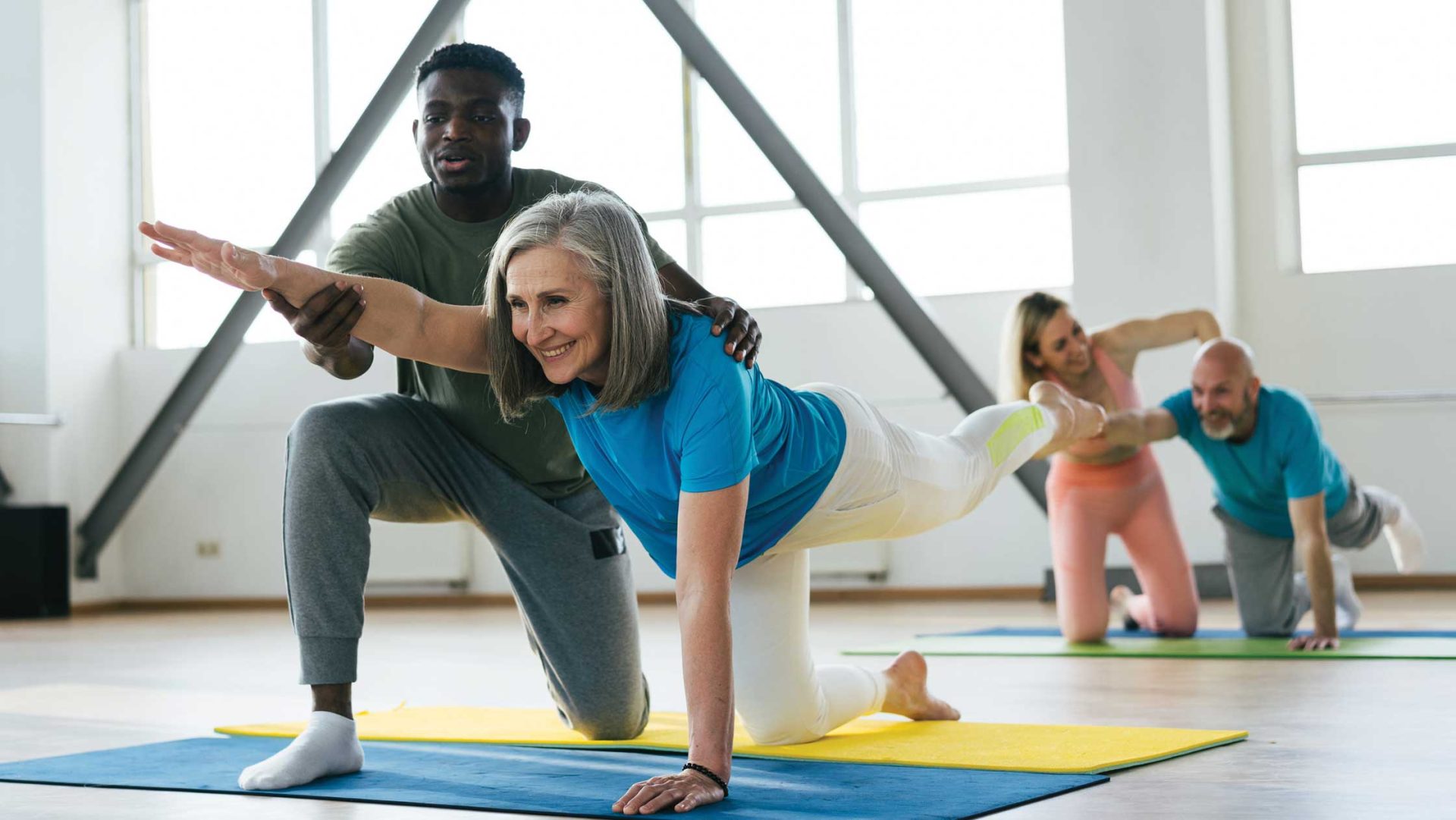
Flex Appeal: Is assisted stretching worth the hype?
Boutique fitness studios seem to be popping up everywhere, offering individualized coaching for all kinds of workouts, from Pilates to CrossFit and everything in between. In the last few years, a new trend has emerged: gyms that focus solely on stretching. These studios, such as Stretch Zone or StretchLab, have been proliferating all over the country (StretchLab, which includes locations in Albany and Latham, recently became the first franchise of its kind to reach 500 studios in North America), providing assisted stretching sessions for people looking to reduce pain and increase flexibility.
For people over the age of 50, who are often encouraged to seek out low-impact exercises that will maximize mobility into their later years, it may seem like assisted stretching is exactly what the doctor ordered. Anecdotally, at least, that seems to be the case, but the science is a bit mixed. Here’s what you should know about the assisted stretching trend.
What is Assisted Stretching?
Assisted stretching involves a trained practitioner moving and stretching your muscles for you, a lot like what you might see on the sidelines of a professional football game. The stretches are done manually and using specialty equipment like rollers or resistance bands, and programs are generally tailored to individuals and their goals.
Sari Medick, the regional general manager of Stretch Zone for Clifton Park, Delmar and Colonie, explains that the first appointment at Stretch Zone involves a detailed assessment of physical fitness to establish a baseline and identify areas of pain or stiffness. “We are not diagnosticians, but we can feel where there is too much tension or you’re moving unevenly. We’re going to find out where that imbalance is and take measurements and try to improve upon it.”
Although there are different methods for assisted stretching, most facilities focus on stretches known as proprioceptive neuromuscular facilitation, or PNF. This technique typically involves a passive stretch, followed by an isometric contraction (against resistance without movement) and then a deeper stretch. PNF is common practice for increasing range of motion, though there isn’t much research to evaluate the theories behind it, according to one review published in the Journal of Human Kinetics.
The Science Behind the Trend
Practitioners claim assisted stretching can increase flexibility, blood circulation and range of motion, decrease pain and stiffness, and improve core strength and posture. So far, though, there hasn’t been much conclusive research on the effectiveness of assisted stretching versus individual stretching, and studies about the benefits of stretching in general have had mixed results.
Research published in the International Journal of Sports Physical Therapy found regular stretching to be beneficial overall, but results were highly individualized to the population studied. More encouragingly, one preliminary study conducted at the University of Miami found that an active assisted-stretching program for older adults increased their range of motion, mobility and functional power — all things associated with living healthier, longer.
Is Assisted Stretching Worth a Try?
Most experts agree that when it comes to fitness, any kind of movement is better than no movement at all. Medick says she has countless success stories she could tell, including her own. “I started off as a client. When they opened here in the Capital Region three years ago, I could not reach my toes,” she says. “I started coming here twice a week for half an hour, and within the first 12 weeks I had made so much progress that I decided to continue on.”
Medick says her work with Stretch Zone has changed her life, allowing her to pursue other fitness passions like weightlifting, dragon boat racing and kayaking in a more “ferocious manner.” Admittedly “no spring chicken” (her words, not mine!), Medick has been battling arthritis since childhood, and she swears that assisted stretching has been the most effective nonmedical intervention she’s tried. “When you are hurting, we all know it makes you miserable, it makes you not want to do stuff,” she says. “But when you feel good, you move better and you move more. And that’s just so important.”