
Learning to fly
The first thing Jessica Lubin wants you to know about aerial yoga is that it’s not a high-wire act. The second thing she wants you to know is that you can absolutely do it.
Lubin is the founder of Good Karma Studio, which opened in Albany in 2011 as the Capital Region’s first — and still only — certified aerial yoga studio. For 15 years, she has been watching first-timers walk through the door with nervous looks on their faces and walk out an hour later, practically glowing.
“That was so accessible!” they tell her. “I feel so good.”
This reaction is especially common among her students over 50, a group Lubin has been building for years. “I have a very strong group I work with weekly who are all over 50, if not in their 70s,” she says. And no, they are not doing anything you’d see in a Cirque du Soleil show (yet). They’re stretching deeply, moving gently and, by the end of class, feeling pretty fantastic.
Sally Annechino, 75, who lives in Westmere, has gotten all three of her daughters and some of her granddaughters into aerial yoga, too. She tried it for the first time in 2011 and has been going ever since.
“I go probably three times a week,” Annechino says. “It gets a little harder as you get older, but I go to the stretch classes, which continue to let me do the things I want to do.”
So What Exactly Is Aerial Yoga?
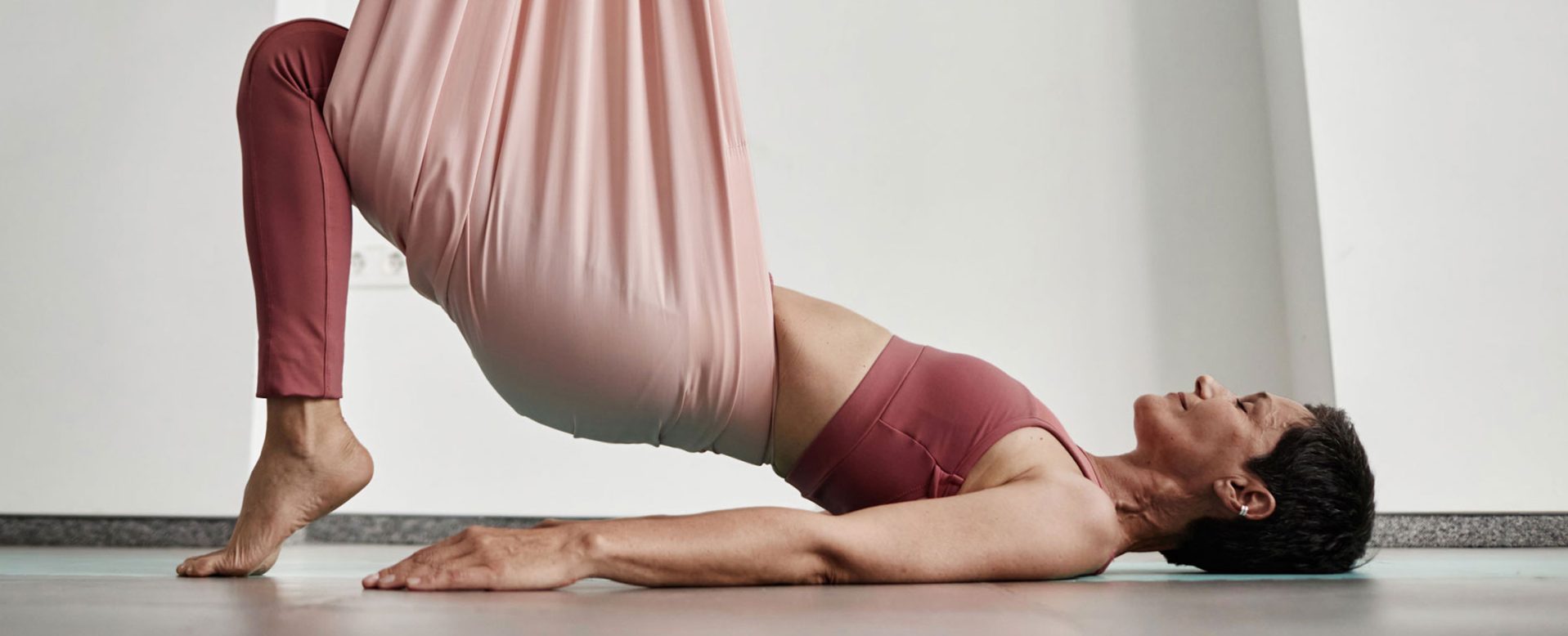
Picture a length of silky, parachute-like fabric hanging from the ceiling in a wide loop. That’s your hammock. You use it the way you’d use a prop in a regular yoga class: as support, as counterbalance, as a way to go deeper into a stretch without straining. Some poses are done standing with the fabric at your back; others involve sitting or lying in the hammock like a gentle cocoon. And yes, some involve hanging upside-down, but don’t worry, you get there slowly, with an instructor guiding every step.
Lubin came to the practice after an injury. “I had injured my back, and aerial yoga was part of my rehab and physical therapy,” she recalls. She had been living in New York City, fell in love with what the hammock did for her spine, and eventually brought the practice home to Albany.
What Your Body Gets Out of It
“I just went to a doctor recently,” she says, “and he found a bunch of arthritis and stenosis in my neck. He said, ‘Just keep doing what you’re doing,’ because it’s put me in good stead.”
For bodies that have logged 50-plus years of gravity, desk chairs and the occasional overdone weekend, the hammock is something of a revelation. The fabric holds part of your weight so that your joints — knees, hips, lower spine — get a break from the compression that builds up over a lifetime of standing and moving. The result is a practice that is gentler on the body than mat yoga, while actually allowing for a deeper stretch.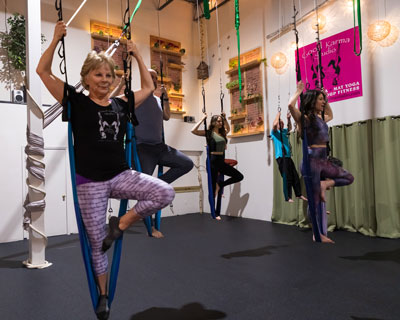
Lubin sees this play out in her restorative classes, where the focus is on the back, hips and core realignment. “We do a lot of deep stretching,” she says. “The way it makes [our clients] feel afterward, mentally, emotionally and confidence-wise, is amazing.”
The hammock also functions as a clever balance aid. For students with wobbly knees or compromised stability, the fabric provides feedback and support that a bare floor simply cannot. “When you’re doing standing postures, it gives you extra balance and support, which people love,” Lubin says. “It also challenges them in a whole new way and makes them feel very successful.”
Then there are the inversions. Hanging partially or fully upside-down sounds alarming, but it offers something that’s surprisingly hard to find elsewhere: gentle spinal decompression. Gravity, which spends most of our lives compressing our vertebrae, suddenly inverts in our favor. Blood flow improves, the spine lengthens, tension in the hips and shoulders releases. A 2016 study sponsored by the American Council on Exercise found that a single 50-minute aerial yoga session offered cardiovascular benefits comparable to a brisk walk, along with measurable improvements in flexibility and core strength.
Broader research on yoga and older adults backs up what instructors like Lubin see in their studios. A 2023 review published in the Annals of Internal Medicine analyzed 33 trials involving nearly 2,400 adults over 65, finding consistent gains in walking speed, leg strength, balance and mental well-being. And yoga’s popularity among Americans over 50 has more than tripled over the past decade, a sign that older adults are clearly discovering that this is their practice, too.
“But I’m Not Flexible/Young/Thin Enough”
“People think things are out of their reach or unattainable,” she says. “I think it’s so important to provide that comfort to people and let them know they can do this. It’s good for you, and it’s fun.” For students with injuries, larger bodies or limited mobility, the fabric becomes a practical tool, a way to get to the floor safely, a prop that replaces a chair, a support system that makes poses possible that a mat never could.
“I grew up in an era of exercise, exercise, exercise,” Annechino says. “It was an era of ‘no pain, no gain.’ This isn’t that.”
And as far as concerns about nausea caused by the aerial swinging and hanging, Annechino says that while she was a little nauseated the first time she went, it quickly passed and never came back.
What to Know Before You Go
Aerial yoga is remarkably accessible, but it’s worth being informed about some of its aspects. The inversions — those upside-down moments — temporarily increase pressure in the eyes and head, so people with glaucoma, uncontrolled high or low blood pressure, heart conditions or severe vertigo should check with their doctor first and inform their instructor before class.
For most people over 50, Lubin recommends starting with a deep stretch class. “Those classes are low to the ground,” she says. It is, she adds, probably the gentlest introduction to the practice you can find.
Wear fitted clothing that covers the backs of your knees and underarms (the fabric can pinch bare skin), skip the big meal beforehand and arrive a few minutes early to chat with the instructor about any concerns.
“It’s my happy place,” says Annechino. “If I could continue going until the day I die, I would be very happy.”
Top image source: iStockphoto.com/SeventyFour